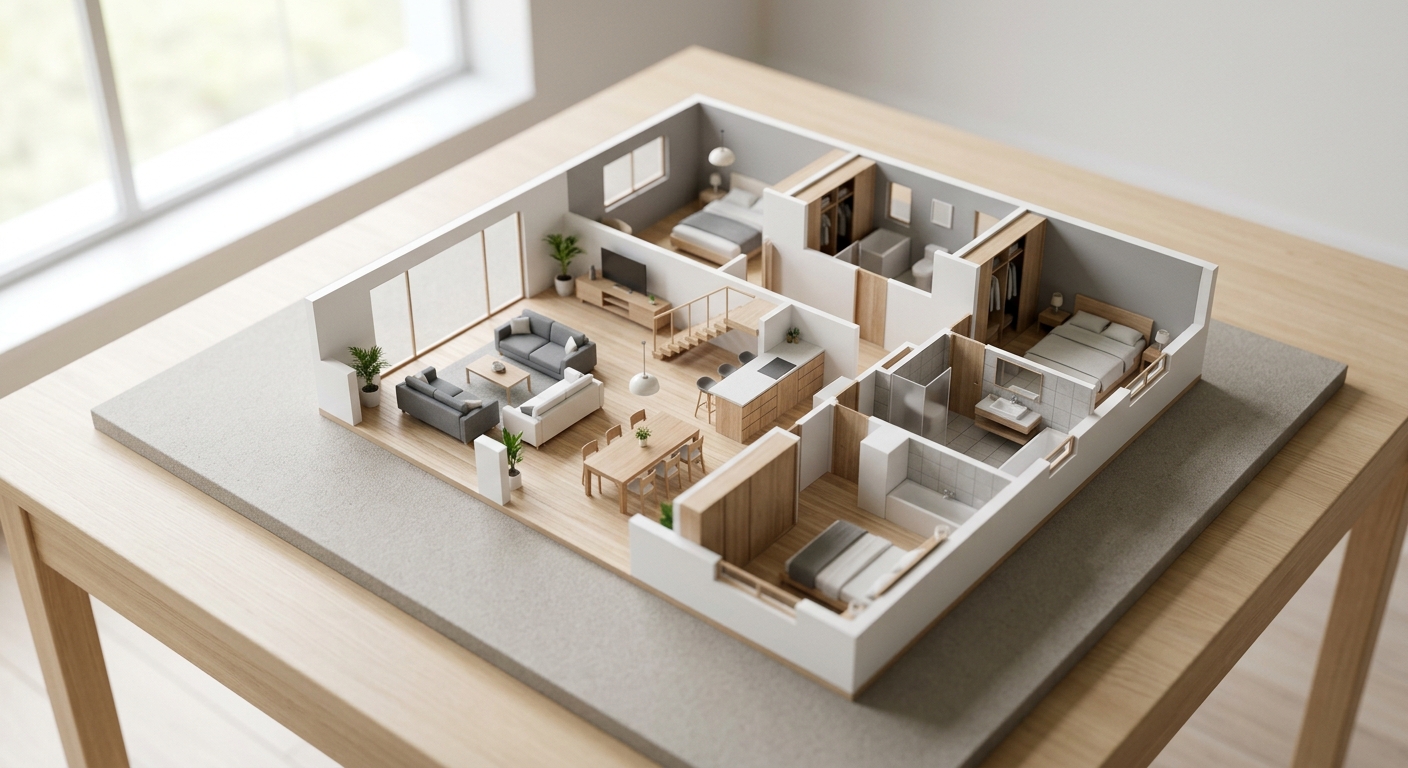
How 3D Floor Plans Help International Buyers Visualize Overseas Homes
Reading time: 8 minutes
You’re scrolling through listings at midnight, timezone-jetlagged, trying to picture whether that “cozy” apartment in Lisbon actually fits your furniture—or your family. Sound familiar? For international buyers, purchasing property sight-unseen has traditionally meant a leap of faith. In 2026, that leap has gotten a lot shorter, thanks to 3D floor plans transforming how buyers evaluate homes thousands of miles away.
Table of Contents
- Why Traditional Listings Fail Remote Buyers
- What Makes 3D Floor Plans Different
- Real Buyer Scenarios: From Confusion to Confidence
- Comparing Visualization Tools: A Data Snapshot
- Common Challenges (and How to Overcome Them)
- Practical Tips for Buyers and Agents
- FAQs
- Your Roadmap Forward
Why Traditional Listings Fail Remote Buyers
Here’s the straight talk: flat photos and vague square-footage numbers were never designed for buyers who can’t physically walk through a property. A 2025 survey by the National Association of Realtors found that 68% of international buyers cited “inability to properly assess layout and space” as their top frustration during overseas property searches. Photos flatten depth perception, hide awkward transitions between rooms, and rarely convey how natural light moves through a space at different times of day.
Quick Scenario: Imagine a Singaporean investor eyeing a three-bedroom villa in Portugal’s Algarve region. Standard listing photos show bright, staged rooms—but nothing reveals that the “third bedroom” is actually a converted storage nook barely wide enough for a twin bed. Without a site visit, this mismatch often surfaces only after a deposit is paid.
The Trust Gap in Cross-Border Real Estate
Trust is the real currency in international property transactions. Buyers are relying on agents, translators, and digital tools to represent reality accurately. When visuals fall short, skepticism grows, negotiations stall, and deals fall through—costing sellers time and buyers confidence. Real estate consultant Elena Marchetti, who specializes in cross-border transactions in Southern Europe, puts it bluntly: “Buyers don’t distrust the property. They distrust their own ability to interpret it from a screen.”
What Makes 3D Floor Plans Different
Unlike static photography, 3D floor plans give buyers a top-down, spatially accurate representation of a home’s layout, dimensions, and flow. Combined with virtual walkthroughs, they let buyers “move” through a property, measure furniture placement mentally, and understand how rooms connect—all without leaving their couch in Toronto, Dubai, or Sydney.
- Accurate spatial reasoning: Buyers can gauge whether a kitchen island fits or a hallway feels cramped.
- Reduced ambiguity: Room dimensions and orientation are displayed clearly, eliminating guesswork.
- Faster decision-making: Buyers shortlist properties more confidently, reducing back-and-forth with agents.
- Emotional connection: Interactive walkthroughs help buyers “feel” the home before ever booking a flight.
Beyond Aesthetics: Functional Decision-Making
3D floor plans aren’t just pretty visuals—they’re decision-support tools. A well-rendered plan answers practical questions: Does the primary bedroom get morning or evening sun? Is the laundry room accessible from the garage? Can a home office fit in that alcove? These functional details matter enormously to buyers relocating for work, retirement, or investment purposes, especially when they can’t easily arrange a second viewing trip.
Real Buyer Scenarios: From Confusion to Confidence
Case Study 1: The Remote Retiree. Margaret, a 61-year-old buyer from Manchester, was searching for a retirement villa in Costa del Sol, Spain, in late 2025. After two disappointing site visits based on misleading photos, her agent introduced interactive 3D floor plans for the next round of listings. Margaret narrowed 14 properties down to three finalists entirely online, then flew out only to finalize her decision—saving an estimated £2,300 in travel costs and two weeks of vacation time.
Case Study 2: The Investment Buyer. A Hong Kong-based investment group evaluating a multi-unit apartment building in Berlin used 3D floor plans to assess renovation feasibility before committing capital. By virtually testing wall removals and layout reconfigurations within the software, they identified that two units could be merged into a higher-value penthouse—a detail invisible in traditional blueprints.
Case Study 3: The Relocating Family. A family relocating from Toronto to Dubai for a corporate assignment needed to confirm that their existing furniture—including an oversized dining table—would fit in a new villa. Using a to-scale 3D plan with furniture placement tools, they resolved the question in under 20 minutes, compared to weeks of email exchanges with the agent measuring rooms manually.
Comparing Visualization Tools: A Data Snapshot
Not all visualization methods deliver equal value. Here’s how common approaches stack up for international buyers in 2026:
| Visualization Method | Spatial Accuracy | Buyer Confidence Boost | Avg. Cost to Seller | Time to Produce |
|---|---|---|---|---|
| Standard Photos Only | Low | 32% | $50–$150 | 1 day |
| 2D Floor Plans | Medium | 51% | $100–$250 | 2–3 days |
| 3D Floor Plans | High | 78% | $250–$600 | 3–5 days |
| Full Virtual Tour + 3D Plan | Very High | 86% | $600–$1,200 | 5–7 days |
| VR Headset Walkthrough | Very High | 89% | $1,000–$2,500 | 7–10 days |
The visualization below illustrates buyer confidence levels associated with each method, based on aggregated 2025-2026 industry surveys:
Common Challenges (and How to Overcome Them)
Challenge 1: Inconsistent Quality Across Markets
Not every listing agency in every country has adopted 3D visualization at the same pace. Buyers eyeing properties in emerging markets—parts of Southeast Asia or Eastern Europe, for instance—may still encounter agencies relying solely on photos. Solution: Ask agents directly whether they can commission a 3D floor plan before you commit to a viewing trip. Many freelance visualization studios now offer 48-hour turnaround for under $400, making this a reasonable request even late in negotiations.
Challenge 2: Misrepresentation or Overly Polished Renders
Some 3D plans, especially for pre-construction or off-plan developments, can be aspirational rather than accurate—featuring furniture, finishes, or room proportions that don’t match the final build. Solution: Request that floor plans include exact measurements in metric and imperial units, and cross-reference against the official architectural blueprint whenever possible. Reputable developers in 2026 increasingly attach certified measurement disclaimers to their 3D renders following stricter EU and UAE advertising standards introduced last year.
Challenge 3: Technology Access and Literacy
Not every buyer is comfortable navigating interactive 3D software, particularly older buyers or those in regions with slower internet infrastructure. Solution: Agents should offer recorded walkthrough videos of the 3D plan as a fallback, alongside live screen-share sessions where an agent navigates the model while narrating key features in real time.
Practical Tips for Buyers and Agents
- Request scale accuracy: Confirm the 3D plan is drawn to precise measurements, not just stylistically proportioned.
- Combine tools: Pair 3D floor plans with a live video call walkthrough for questions that static models can’t answer, like noise levels or neighborhood feel.
- Test furniture fit digitally: Many 3D platforms allow buyers to input custom furniture dimensions to simulate their own belongings in the space.
- Check for orientation data: Sun direction indicators on 3D plans reveal natural lighting patterns crucial to comfort in different climates.
- Verify before wiring funds: Never finalize a purchase based on visualization alone—use it to shortlist, then verify critical details through a local inspector or trusted representative.
FAQs
Do 3D floor plans replace the need for an in-person visit?
Not entirely. They dramatically reduce the number of properties you need to visit physically by helping you eliminate poor fits early. Most experienced international buyers still recommend an in-person or trusted-representative inspection before finalizing a purchase, particularly for older properties where structural issues aren’t visible in digital models.
Are 3D floor plans expensive for sellers to produce?
Costs have dropped significantly since 2023. As of 2026, professional 3D floor plans typically range from $250 to $600 depending on property size and complexity, with many agencies now bundling this service into standard listing packages for international-facing properties.
Can I trust the accuracy of 3D floor plans from developers selling off-plan properties?
Exercise reasonable caution. Regulatory bodies in several countries, including the EU and UAE, have tightened disclosure requirements for off-plan marketing materials in the past year, but standards still vary globally. Always request certified measurements and compare the 3D render against official architectural documents before signing any agreement.
Your Roadmap Forward
The shift toward immersive visualization isn’t a passing trend—it’s becoming the baseline expectation for cross-border real estate transactions as buyer pools grow more global and more remote-first. Here’s how to move forward with confidence:
- Step 1: Before your next overseas property search, ask agents upfront whether 3D floor plans are available or can be commissioned.
- Step 2: Use 3D plans to build a shortlist of 3-5 serious contenders before scheduling any travel.
- Step 3: Pair digital walkthroughs with a live video call to ask questions about light, noise, and neighborhood context.
- Step 4: Always verify critical measurements and structural details through an independent local inspector before finalizing any deal.
Buying a home from another continent will always carry some inherent uncertainty—but with 3D floor plans, you’re no longer navigating that uncertainty blind. So the next time you’re evaluating a listing from thousands of miles away, ask yourself: are you seeing the space, or just the pictures? Choose the tools that let you truly see it.
About the Author
